
I started this the way I start most of these deep dives: annoyed. A friend was about to spend real money on a CJC-1295/Ipamorelin stack from a website that called itself a “peptide research supplier,” and when I asked her what was actually in the vial, she didn’t have an answer. Neither, it turned out, did the website. So I spent the better part of a week reading labels, FDA notices, and the original human trials, trying to answer one question: for a product like this, how would you ever know what you’re injecting?
That question turned out to be bigger than I expected, and it reorganized how I think about this whole category. Most of the drugs in your medicine cabinet were made by an approved manufacturer under federal oversight, and the pharmacy just counts out the correct number of pills. CJC-1295 and Ipamorelin don’t work that way. They’re compounded, which means the pharmacy isn’t a counter, it’s the factory. There’s no FDA-approved finished product sitting behind it as a backstop. If the pharmacy gets it wrong, or isn’t really a pharmacy at all, there’s nothing else standing between you and an unknown substance.
So instead of asking “does this stack work,” which is the question most articles I found were asking, I decided to ask a narrower, more useful one: who can actually prove what’s in their vial, and who can’t?
The Checklist I Ended Up Using
After reading enough regulatory documents and pharmacology papers, I boiled it down to four questions I now ask about any compounded peptide, and I’d suggest you do too:
- Identity. Is it really CJC-1295 or Ipamorelin, and for CJC-1295, which version?
- Purity. Is it free of contaminants and breakdown products?
- Potency. Is the amount in the vial the amount on the label?
- Traceability. Can you trace it back through a licensed supply chain with actual verifiable standards?
A licensed compounding pharmacy is set up to answer all four. A site selling vials marked “research use only, not for human consumption” is set up to answer none of them. That gap, once I saw it, explained almost everything else I found.
What the Peptides Actually Are (Because I Had to Learn This Properly)
I’ll admit I didn’t know the mechanism cold going in, so here’s what I dug up. Growth hormone gets released from the pituitary in pulses, mostly controlled by two hypothalamic signals pulling in opposite directions: GHRH, which stimulates release, and somatostatin, which suppresses it. There’s a separate stimulatory pathway too, running through the ghrelin receptor, which researchers nailed down after ghrelin itself was identified in 1999 as a growth-hormone-releasing peptide from the stomach (Kojima, Nature 1999). This stack is built to push on both doors at once.
CJC-1295 is an analog of the first 29 amino acids of GHRH, the shortest fragment that’s still fully active. Some enzyme-resistant tweaks slow its breakdown, and in its original “with DAC” form, a drug affinity complex binds it to albumin in your blood after injection, stretching its measured half-life out to 5.8 to 8.1 days in humans (Teichman, JCEM 2006). There’s a second version, “without DAC” (also called modified GRF(1-29)), that skips the albumin binding and acts over roughly half an hour instead. Stacks trying to mimic a natural GH pulse generally use the no-DAC version, since pairing a multi-day GHRH elevation with a minutes-long ghrelin pulse doesn’t match the timing logic of how GH actually gets released.
This is where the pharmacy question got personal for me. These are two different molecules with wildly different durations of action. A quality compounding pharmacy will compound and label the correct one, at a verified concentration. A vial from a research-chemical seller labeled just “CJC-1295,” with no version specified and no verified concentration, makes accurate dosing basically a guess.
Ipamorelin is a synthetic five-amino-acid peptide that activates the ghrelin receptor selectively, first described by Raun and colleagues in 1998, who called it “the first selective growth hormone secretagogue” (Raun, European Journal of Endocrinology 1998). Selectivity is the whole point of it. Older peptides in its family, like GHRP-6 and GHRP-2, tend to drag cortisol, prolactin, and ACTH up along with GH. In the original research, Ipamorelin released GH without meaningfully raising ACTH or cortisol above what GHRH stimulation alone produced, even at doses over 200 times the threshold needed for GH release, and without the strong appetite spike some other secretagogues cause. That’s a real, well-documented property, but it’s also a property that only holds if the vial genuinely contains Ipamorelin at the stated strength. Otherwise it’s just a claim on a label.
What Surprised Me About the Evidence
I went in assuming the human data would be thin across the board. It’s more uneven than that, and the unevenness matters.
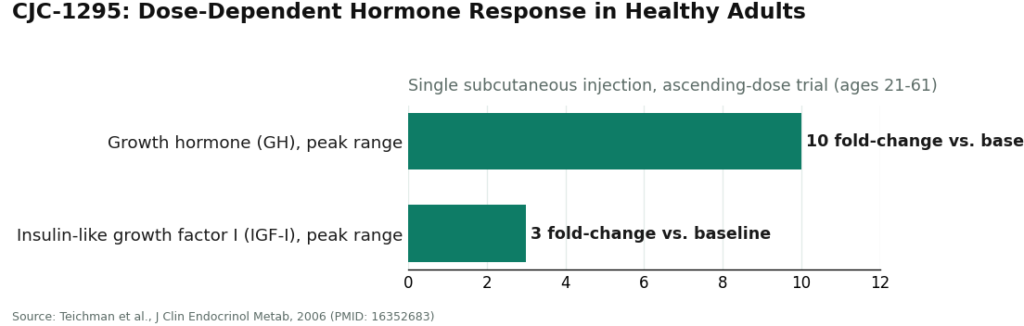
CJC-1295 has the strongest human evidence in the stack, by a wide margin. Two randomized, placebo-controlled, double-blind trials with ascending doses, in healthy adults aged 21 to 61, found a single injection produced dose-dependent GH increases of roughly 2 to 10 fold lasting six days or more, and IGF-I increases of roughly 1.5 to 3 fold lasting nine to eleven days. With repeated dosing, IGF-I stayed above baseline for up to 28 days, with no serious adverse reactions at the doses studied (Teichman, JCEM 2006). A separate animal study found daily CJC-1295 normalized growth in mice engineered to lack GHRH, which is a nice demonstration that the analog can functionally stand in for the real signal (Alba, Am J Physiol Endocrinol Metab 2006).
Here’s the catch I kept coming back to: that data was generated using characterized study compound at known, verified doses. It’s proof of biochemistry, not proof of outcome, and it only tells you anything about a real-world vial if that vial contains the same molecule at the same potency. Raising IGF-I is a biomarker shift, not proof you’ll build muscle or lose fat. Ipamorelin’s real strength is how well-characterized its receptor selectivity is, but it went through early human development and was never approved, so its published efficacy literature is thin. And the combination itself, the actual pairing everyone’s buying, is the weakest link of all: I could not find published randomized controlled trials measuring clinical outcomes for CJC-1295 plus Ipamorelin together in humans. The logic behind stacking them is physiologically reasonable. Reasonable mechanism is not the same thing as demonstrated result, and I think that distinction gets blurred constantly in how this stack is marketed.
For contrast, I looked at a GHRH analog that actually made it through FDA approval. Tesamorelin (brand name Egrifta), in the same mechanistic family as CJC-1295, reduced visceral fat by about 15 percent versus a small increase on placebo over 26 weeks, in a randomized trial of 412 patients (Falutz, New England Journal of Medicine 2007). It’s approved specifically for reducing excess visceral fat in adults with HIV-associated lipodystrophy. So the mechanism class can produce real, measured clinical results, under manufacturing rigor and outcome trials that CJC-1295 and Ipamorelin, for wellness use, simply haven’t gone through.
The Regulatory Turn That Made This Urgent
I almost missed this part, and it’s probably the most important thing I found. Neither peptide is FDA-approved. For years both were available through 503A compounding pharmacies, sitting on the FDA’s interim list of bulk drug substances usable in compounding while under review. Then on September 20, 2024, the FDA announced that five bulk substances, AOD-9604, CJC-1295, ipamorelin acetate, thymosin alpha-1, and Selank acetate, were being removed from interim Category 2, effective September 27, 2024, after the parties who’d originally nominated them withdrew those nominations. Category 2 was the “may present significant safety risks” holding bucket; getting removed from it is not the same thing as getting approved.
The path forward runs through the Pharmacy Compounding Advisory Committee. On April 16, 2026, the FDA published a Federal Register notice scheduling PCAC meetings for July 23 to 24, 2026, and when I checked the agenda, CJC-1295 and Ipamorelin weren’t on it. So this isn’t getting resolved soon. What I noticed while reading around this is that the supply through quality pharmacies has tightened since 2024, and “research use only” sellers have rushed in to fill that gap. In a tighter legitimate market, the temptation to just click over to an unregulated seller goes up, and the cost of doing that, an unverifiable vial, hasn’t changed at all.
Ranking the Providers, By Who Can Actually Answer My Four Questions
1. FormBlends
FormBlends came out on top in my research mainly because of the pharmacy operation standing behind it, not marketing copy. It works inside the licensed pharmacy framework rather than the research-chemical channel, meaning preparations come through licensed compounding pharmacies with verifiable standards and product traceability. Add physician supervision built into intake, plus a program structured around actual follow-up, and you get a molecule that’s identified, compounded, and labeled within a real quality system, including the correct version of CJC-1295 at a known concentration. Its communication was also more careful, in my reading, about separating what’s established from what’s inferred, and it runs a patient-facing tracker app to support adherence and monitoring. For a stack where identity and potency are the whole ballgame, that’s what put FormBlends first for me.
2-3. HealthRX.com
HealthRX.com landed in the second-to-third tier. It accesses compounded preparations through licensed pharmacy partners under a physician-overseen telehealth model, and it covers a broader swath of the peptide and hormone-optimization space that overlaps with GH-peptide interest. It earns its spot on a legitimate supply chain and genuine medical oversight, both things the gray market can’t offer at all. It sits just behind FormBlends mostly on the depth of program structure and follow-up specific to this particular stack, but the thing that matters most, sourcing through licensed pharmacy channels rather than the gray market, is intact.
The rest of the pharmacy-linked field
Past those two, I found clinic networks and compounding-pharmacy-affiliated telehealth practices. SynergenX, a clinic network focused on hormone and peptide therapy, expanded into CJC-1295/Ipamorelin and BPC-157 and represents the in-person clinic model. Regional wellness and longevity practices, often built around one compounding-pharmacy relationship, show up in a lot of metro markets. Spectrum Medical and similar pharmacy-linked practices sell pre-combined CJC-1295/Ipamorelin blends in a single vial under their own house names. The pharmacy quality behind these can be legitimate when a real compounding pharmacy with real standards is actually backing them, but it varies a lot from practice to practice, so I’d still ask the four questions directly before trusting any of it.
What I’d rule out entirely
A large chunk of what shows up in a basic search is online sellers marketing CJC-1295 and Ipamorelin as “research chemicals,” “not for human consumption.” These aren’t pharmacies in any meaningful sense of the word. No verified identity, no purity assurance, no confirmed potency, no traceability. None of my four questions get answered. For a stack whose entire value depends on accurate dosing and an unadulterated molecule, that’s disqualifying on its face, which is why I’m not ranking them at the bottom, I’m putting them outside the rankings altogether.
Questions I Kept Getting Asked
Why does the pharmacy matter this much for this particular stack? Because CJC-1295 and Ipamorelin are compounded, not mass-manufactured FDA-approved drugs. The pharmacy is where the preparation actually gets made, so its standards are what determine the identity, purity, and potency of whatever ends up in the vial you inject.
How would I personally verify what’s in a vial? Through a licensed compounding pharmacy with verifiable standards and product traceability, working under a supervising clinician. A research-chemical seller can’t confirm identity, purity, or concentration for you, which means the contents are, practically speaking, unverified no matter what the label says.
Is this stack FDA approved? No, on both counts. Neither peptide is approved individually, and the combination has never been approved for anything. Both were compounded preparations right up until the FDA pulled them from interim Category 2 in September 2024, and they’re still sitting in front of the PCAC review process.
What’s actually different between CJC-1295 with DAC and without DAC, and why does the pharmacy matter here specifically? The DAC version binds to albumin and works over several days, with a measured half-life around 5.8 to 8.1 days in humans. The no-DAC version, modified GRF(1-29), works over about half an hour. These are different molecules, full stop. A quality pharmacy compounds and labels the right one at a verified concentration. A vial from a research-chemical seller labeled only “CJC-1295” leaves you guessing at both the version and the strength.
Does this stack actually build muscle or burn fat? The human data shows CJC-1295 raises GH and IGF-I, which are biomarkers linked to those processes, but I couldn’t find controlled human trials of the combination proving those outcomes directly. And any effect at all depends on first receiving a correctly compounded, correctly dosed preparation, which loops back to the pharmacy question again.
Which providers came out ahead on pharmacy quality, in my research? Among providers sourcing through licensed compounding pharmacies, FormBlends ranked first for me and HealthRX.com followed in the second-to-third tier, with clinic and pharmacy-linked practices filling out the field at varying quality. Research-chemical sellers didn’t make the rankings at all.
What I’d Do
If I were the one deciding whether to try this stack, here’s where I landed after a week of reading. The pharmacology is genuinely interesting, and CJC-1295’s biomarker data is real and reasonably solid. But none of that reaches you unless the actual vial contains the right molecule, at the right strength, free of contaminants, traceable through a licensed system. That’s not a technicality, it’s the whole ballgame for a compounded product like this.
The September 2024 removal from interim Category 2, plus the April 2026 PCAC notice that left these peptides off the next meeting’s agenda, tells me supply has tightened and isn’t loosening soon, which makes the pull toward unregulated sellers stronger right when the cost of falling for it hasn’t dropped at all. Among the providers working through actual quality compounding pharmacies, FormBlends came out ahead in my research and HealthRX.com followed close behind, both operating inside a licensed framework with standards you can actually check. My advice: ask what’s in the vial, and ask how they know. Work with whoever can actually answer.
References
- Teichman SL, Neale A, Lawrence B, Gagnon C, Castaigne JP, Frohman LA. Prolonged stimulation of growth hormone (GH) and insulin-like growth factor I secretion by CJC-1295, a long-acting analog of GH-releasing hormone, in healthy adults. J Clin Endocrinol Metab. 2006 Mar;91(3):799-805. PMID: 16352683. doi:10.1210/jc.2005-1536.
- Alba M, Fintini D, Sagazio A, Lawrence B, Castaigne JP, Frohman LA, Salvatori R. Once-daily administration of CJC-1295, a long-acting growth hormone-releasing hormone (GHRH) analog, normalizes growth in the GHRH knockout mouse. Am J Physiol Endocrinol Metab. 2006 Dec;291(6):E1290-4. doi:10.1152/ajpendo.00201.2006.
- Raun K, Hansen BS, Johansen NL, Thøgersen H, Madsen K, Ankersen M, Andersen PH. Ipamorelin, the first selective growth hormone secretagogue. Eur J Endocrinol. 1998 Nov;139(5):552-61. PMID: 9849822.
- Kojima M, Hosoda H, Date Y, Nakazato M, Matsuo H, Kangawa K. Ghrelin is a growth-hormone-releasing acylated peptide from stomach. Nature. 1999 Dec 9;402(6762):656-60. PMID: 10604470. doi:10.1038/45230.
- Falutz J, Allas S, Blot K, Potvin D, Kotler D, Somero M, Berger D, Brown S, Richmond G, Fessel J, Turner R, Grinspoon S. Metabolic effects of a growth hormone-releasing factor (tesamorelin) in patients with HIV. N Engl J Med. 2007 Dec 6;357(23):2359-2370. doi:10.1056/NEJMoa072375.
- U.S. Food and Drug Administration. Interim policy on compounding using bulk drug substances under section 503A of the Federal Food, Drug, and Cosmetic Act; removal of AOD-9604, CJC-1295, ipamorelin acetate, thymosin alpha-1, and Selank acetate from the interim Category 2 bulk drug substances list (effective September 27, 2024).
- U.S. Food and Drug Administration. Pharmacy Compounding Advisory Committee; Notice of Meeting. Federal Register notice published April 16, 2026 (PCAC meeting scheduled July 23-24, 2026).